Why overspecialization is over, and how I decided to create my own AI device on MCU
In this series of articles, I'd like to show you how to create your own ESP32-S3-based device with ML built right into the firmware. 🟠 I'll try to describe not only what I'm doing, but also how I got there—all the decisions, compromises, and challenges that arose along the way.
Why did I even take this on??
The reasons are actually quite simple—and honest.
-
It's an objectively difficult challenge. I don't have extensive, multi-year experience working with microcontrollers, and my knowledge of ML is only basic.
But that's precisely why the idea seemed interesting: it's a task with many unknowns, and it requires combining different skills into a single system. -
I want to improve my Rust skills
I've been using Rust for a long time, and it's become my primary tool for many projects.
Therefore, the choice for firmware was obvious: Rust → safety, control, predictability, and a sign of engineering quality.
Moreover, I want to show that Rust firmware isn't exotic, but a fully functional approach. -
Build a full cycle: MCU → AI → Actix Web → Dashboard Narrow specialization is being replaced by generalist engineers who understand the product as a whole.
That's why I'm interested in following the entire IoT product journey:
- assembling the hardware,
- integrating TinyML inference,
- setting up Wi-Fi and MQTT,
- processing data on the server,
- displaying statistics and graphs on the dashboard. I want to cover the entire stack—from the registry to the UI.
- Document your journey
want to document this journey: the approaches, the conclusions, the decisions made.
This will be useful for me in the future, and perhaps for other developers reading this series, my employers, or my partners.
What exactly do I want to build?
My future device will contain:
- AI inference for image classification and human feature detection
- Camera and image processing stream
- Wi-Fi connection via QR code with the ability to reset network settings
- Obtaining UTC time
- Communication with the server via MQTT
The server side will be responsible for:
- Authorization processing
- Collecting and processing data from devices
- API
On the front end, I see the following as optimal:
- User/device personal account
- Real-time event log
- Graphs and statistics for human detection data
- Device cards
The main stages of this project are:
- Training and optimizing the machine learning model
- Creating firmware on the MCU and integrating the model into it
- Configuring a transport layer for MCU communication with the outside world
- Creating a server for receiving data, processing it, and managing authorizations
- Data visualization and working with UI/UX
- Creating a prototype enclosure for 3D printing
Project architecture (high-level plan)
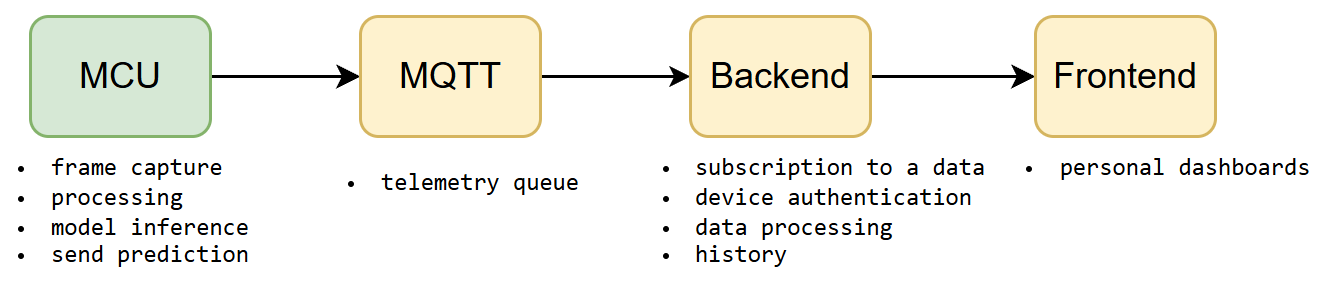
How the article series will be structured
I'll try to divide the entire journey into logical modules.
In the following articles, I'll cover:
- Hardware, component selection, and Rust firmware organization
- TinyML and MCU models
- Running inference: the real pipeline
- Network: Wi-Fi, MQTT, HTTP
- Backend on Actix
- Dashboard
- 3D modeling
- Current results and plans